






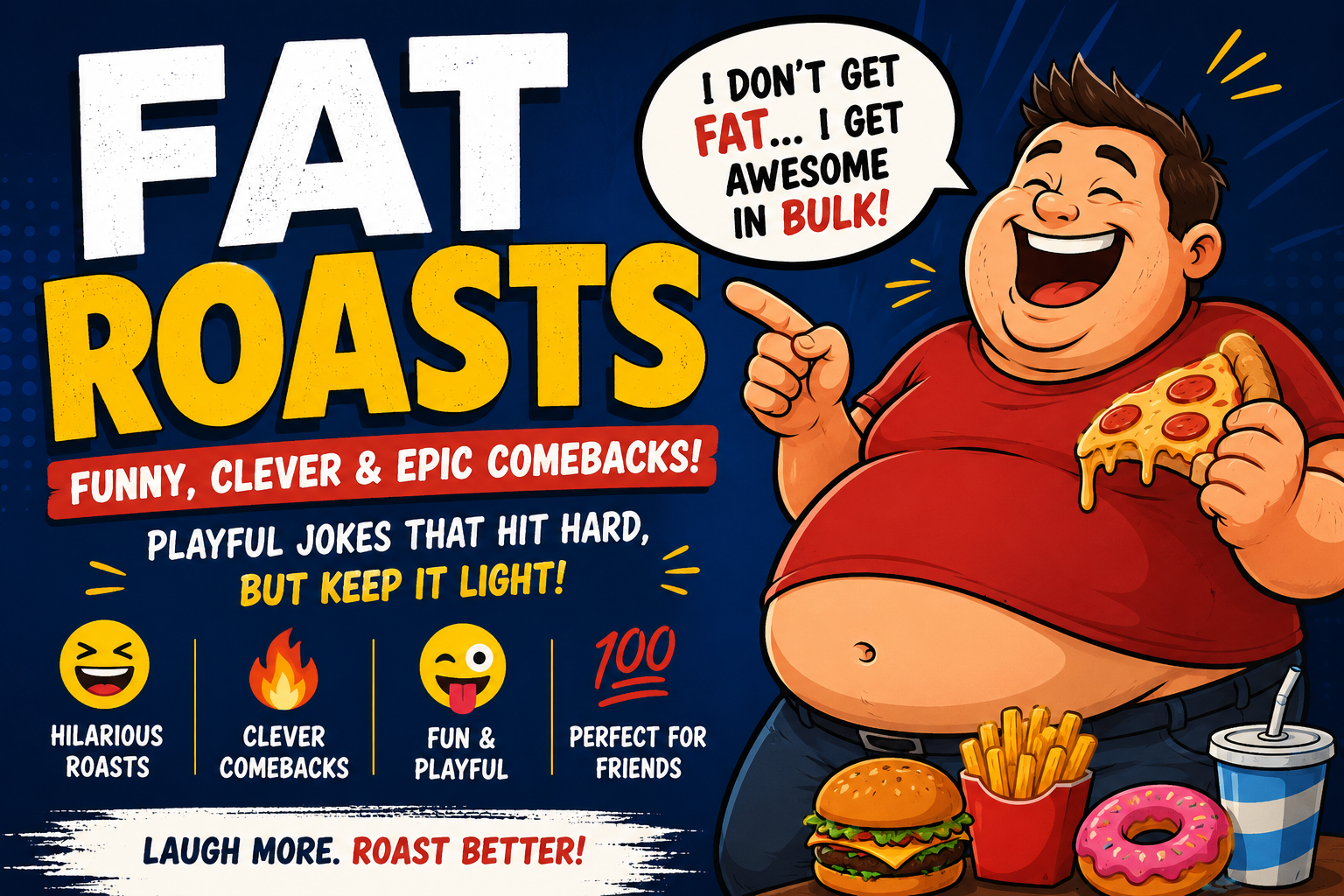
Humor has always been a way for people to connect, tease their friends, and turn ordinary situations into memorable moments. Roasting is one of the most popular forms of modern humor because it combines exaggeration, sarcasm, timing, and creativity. However, jokes about someone’s body or appearance can easily become hurtful if they are written without consideration.
The best fat roasts are not necessarily the harshest ones. Clever jokes can create a funny moment without turning someone’s weight into a reason for humiliation. Good roasting depends more on imagination than insults. A creative roast can exaggerate an everyday situation, compare something harmless to a funny scenario, or use unexpected wordplay to make people laugh.
This guide explores how playful weight-related humor works, how to make jokes more creative, and how to keep roasting entertaining rather than genuinely offensive.
What Makes a Roast Funny?
A roast is essentially an exaggerated joke aimed at a person, situation, habit, or idea. The humor often comes from taking something recognizable and pushing it to an absurd level.
For example, instead of simply making a negative comment about someone’s appearance, a clever roast might compare their oversized hoodie to a camping tent or joke that their snack drawer deserves its own address.
The exaggeration creates the comedy.
Several elements can make a roast more effective:
- Timing: A joke works better when delivered at the right moment.
- Creativity: Unexpected comparisons are usually funnier than obvious insults.
- Exaggeration: Taking an ordinary situation to an absurd extreme creates surprise.
- Wordplay: Clever wording can make even a simple joke memorable.
- Context: A joke that fits the situation feels more natural.
- Tone: Friendly teasing is very different from genuine humiliation.
The goal should be to make the situation funny rather than make another person feel worthless.
Why Weight-Related Roasts Can Be Sensitive
Weight is a personal subject for many people. Unlike joking about someone’s obsession with coffee or their terrible music playlist, comments about body size can touch on confidence, health, or personal experiences.
That is why context matters.
A roast exchanged between close friends who already enjoy teasing each other may be received differently from the same joke directed toward a stranger. Even then, knowing someone’s boundaries is important.
Good humor should have a sense of proportion. If everyone is laughing together, the joke can remain playful. If one person is clearly uncomfortable, continuing the roast usually stops being funny.
The strongest comedians understand that being clever is more impressive than being cruel.
Clever Ideas for Playful Roasting
When creating funny material, it helps to focus on fictional exaggeration rather than direct insults. Imagine ridiculous situations and build jokes around them.
Here are some playful concepts:
- A person’s snack collection could be described as an emergency food reserve.
- An oversized chair could be called a luxury parking space.
- A large hoodie could be compared to portable furniture.
- A trip to the refrigerator could be treated like an important expedition.
- A buffet could be described as a reunion between old friends.
- A grocery cart could be joked about as someone’s weekend project.
- A favorite restaurant could be described as a second home.
- A pizza box could be humorously treated like a briefcase.
These concepts allow the joke to remain exaggerated without reducing a person to their body.
Short Fat Roasts for Friendly Banter
Short jokes are often easier to remember and deliver naturally. The key is keeping them light and obviously exaggerated.
Here are some examples of playful roast-style lines:
- “That hoodie isn’t oversized; it’s practically real estate.”
- “Your snack drawer has better organization than my office.”
- “You don’t visit the buffet—the buffet gets visited by you.”
- “That chair isn’t furniture anymore; it’s part of the family.”
- “Your refrigerator probably recognizes your footsteps.”
- “You call it a snack. Your snack calls it dinner.”
- “Your food delivery driver probably knows your schedule better than your friends.”
- “That jacket has enough room for a small vacation.”
- “You opened the fridge like it was going to reveal a plot twist.”
- “Your grocery list looks like preparation for a three-month expedition.”
The humor comes from the absurdity of the situation rather than simply saying something negative about someone’s body.
Funny Roast Ideas Based on Food
Food is one of the easiest themes to use for playful humor because everyone can relate to eating.
Instead of focusing directly on weight, jokes can revolve around exaggerated food habits.
Imagine someone ordering a meal and then adding several sides. A playful roast might describe the order as “a small catering contract.”
Someone who always carries snacks could be jokingly called the “official emergency food department.”
A person who loves pizza might be teased about having a personal relationship with the delivery app.
These jokes work because the punchline is about behavior and exaggeration.
The same approach can be used with burgers, desserts, chips, sandwiches, ice cream, or any other favorite food.
Fat Roasts Using Exaggeration
Exaggeration is one of the oldest comedy techniques because audiences understand that the statement is intentionally ridiculous.
For example, saying someone ate a lot is ordinary. Saying they ordered enough food to feed an entire football team creates a more humorous image.
The trick is making the comparison obviously impossible.
You can exaggerate:
- The amount of food someone ordered.
- The size of their favorite hoodie.
- The amount of space occupied by their snack collection.
- How often they visit a favorite restaurant.
- How seriously they take dessert.
- How quickly they notice someone opening a bag of chips.
- How protective they are of their leftovers.
These ideas provide plenty of material without relying entirely on appearance-based insults.
How to Roast Your Friends Without Being Mean
Friendly roasting depends heavily on the relationship between the people involved.
Before making a joke, consider whether the person normally enjoys this type of humor. Some friends love aggressive banter, while others prefer gentle jokes.
A useful rule is to avoid sensitive subjects unless you already know they are comfortable with them.
You can also balance a roast with something positive. For example, teasing someone’s enormous food order can be followed by a compliment about their excellent taste.
This keeps the interaction playful.
Another important technique is to roast yourself occasionally. Self-deprecating humor can make group banter feel less one-sided because everyone becomes part of the joke.
The Difference Between Roasting and Bullying
Roasting and bullying can look similar on the surface, but their intentions and effects are very different.
A roast is generally playful, mutual, and understood as humor. Bullying is intended to embarrass, intimidate, or hurt someone.
Consider these differences:
| Friendly Roasting | Bullying |
|---|---|
| Usually mutual | Usually one-sided |
| Intended to entertain | Intended to hurt |
| Respects boundaries | Ignores boundaries |
| Uses playful exaggeration | Uses humiliation |
| Can be stopped easily | Often continues despite discomfort |
| Everyone can participate | One person becomes the target |
The distinction matters because a joke does not automatically become harmless simply because someone calls it a roast.
How to Write Better Roast Jokes
Writing effective roast humor requires observation and creativity.
Start with something recognizable. Perhaps the person always orders dessert, wears the same oversized sweatshirt, or keeps snacks in every room.
Next, exaggerate that behavior.
Finally, add an unexpected comparison.
For example:
Observation: They always carry snacks.
Exaggeration: They carry enough snacks for an emergency.
Unexpected comparison: Their backpack resembles a mobile convenience store.
That structure creates a simple joke without needing a harsh insult.
Another technique is the “fake serious explanation.” Treat a silly habit as if it were a major scientific discovery or government operation.
For instance, someone repeatedly checking the refrigerator could become a joke about conducting “important kitchen research.”
The contrast between the serious language and the ordinary activity creates humor.
Why Delivery Matters More Than the Joke
Even a great joke can fail if it is delivered badly.
Tone, facial expression, timing, and confidence all influence how a roast is received.
A playful smile can communicate that you are joking. A hostile tone can make exactly the same sentence sound insulting.
Timing is also important. Avoid dropping a personal roast into a serious conversation. Humor works best when the environment supports it.
Good comedians also know when to stop. If the joke gets a laugh, there is no need to repeat it five more times.
Sometimes the strongest move is simply moving on to another subject.
Funny Roasts Without Mentioning Weight
If you want to keep the humor safer, roast personality traits or situations instead.
You can joke about:
- Terrible cooking skills
- Obsession with smartphones
- Always being late
- Excessive coffee consumption
- Bad fashion choices
- Forgetting passwords
- Watching too many shows
- Being addicted to online shopping
- Taking forever to reply to messages
- Having too many tabs open
- Being unable to choose a restaurant
- Constantly losing keys
These subjects can often produce stronger jokes because they provide more creative possibilities.
A person who takes 30 minutes to choose what to eat can inspire dozens of jokes without mentioning their body at all.
The Role of Wordplay in Roasting
Wordplay can turn a basic joke into something much more memorable.
Instead of directly insulting someone, use double meanings, unexpected phrases, or creative descriptions.
For example, someone who loves snacks might be described as having a “professional relationship with the pantry.”
Someone who frequently orders food could be said to have “premium membership in the delivery economy.”
These descriptions are funny because they transform ordinary behavior into something absurd.
Good wordplay also makes the roast feel more original.
Social Media and Roast Culture
Roasting has become especially popular on social media. Memes, short videos, comment sections, and comedy pages regularly use exaggerated humor to entertain audiences.
However, online humor has an additional challenge: context can disappear.
A joke between friends may be harmless in person but look much harsher when posted publicly. People reading a comment may not know the relationship between the individuals involved.
For that reason, social media roasts should be written with extra care.
Creative jokes that rely on exaggeration and fictional scenarios are generally easier for audiences to understand as humor than direct attacks on someone’s appearance.
How to Keep Roast Humor Original
If you want your jokes to stand out, avoid repeating common internet insults.
Original humor comes from observation.
Think about the specific situation in front of you. What unusual habit does the person have? What funny comparison could describe it? What absurd scenario could you create around it?
For example, instead of using the same predictable food joke, imagine that someone’s snack cupboard has become a “24-hour convenience store with one employee.”
The more specific the setup, the more original the punchline can feel.
You can also combine unrelated subjects. Compare someone’s eating habits to space exploration, office meetings, video games, transportation, or weather forecasts.
Unexpected combinations often create better comedy.
When a Roast Should Be Avoided
There are situations where roasting is simply not appropriate.
Avoid personal jokes when someone is visibly upset, dealing with a difficult situation, or has clearly asked you to stop. Do not use humor as an excuse to repeatedly target someone.
You should also be cautious in professional environments, classrooms, public settings, and unfamiliar groups.
The safest approach is simple: if you are unsure whether someone will enjoy the joke, choose a different topic.
There are millions of things to joke about that do not require targeting someone’s insecurities.
Final Thoughts on Fat Roasts
The best fat roasts are creative, exaggerated, and playful rather than genuinely cruel. Humor becomes more effective when it focuses on ridiculous situations, food habits, oversized clothing, fictional scenarios, and clever comparisons.
A memorable roast does not need to make someone feel bad. It needs an unexpected idea, good timing, and a punchline that people can enjoy.
If you are creating roast content for friends, social media, comedy pages, or casual conversations, focus on originality. Use exaggeration, wordplay, and harmless observations to create jokes that feel fresh.
Most importantly, remember that the purpose of a roast is entertainment. When everyone can laugh—including the person being teased—the joke has achieved what good humor is supposed to do.