









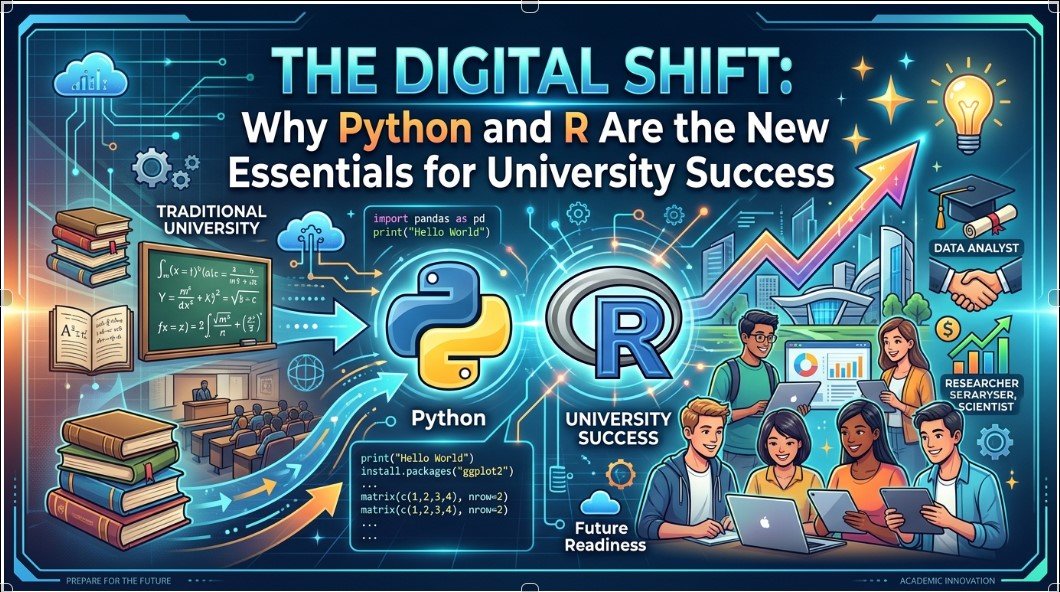
The landscape of higher education in Australia and across the globe has shifted. Gone are the days when programming was a niche skill reserved for computer science students tucked away in basement labs. Today, whether you are studying Marine Biology at JCU, Finance at UniMelb, or Psychology at USYD, code is becoming the primary language of research and analysis. Specifically, Python and R have emerged as the heavyweights of the academic world.
But why these two? And how does learning to code actually make you a more productive student rather than just adding another burden to your heavy study load? Let’s break down the transformation of modern degrees and how mastering these tools ensures you stay ahead of the curve.
The Evolution of the Modern Degree
For decades, the standard toolkit for a university student involved a word processor and a spreadsheet program. While these are still useful, they have clear ceilings. When dealing with modern datasets—which can include thousands of rows of social media sentiment, years of climate data, or complex genomic sequences—manual entry and basic formulas fall apart.
This is where Python and R step in. They allow students to automate the “boring stuff,” leaving more room for critical thinking and actual discovery. Universities now recognize that a graduate who can write a script to scrape data is far more valuable to employers than one who can only perform manual data entry.
Python: The Versatile Multi-Tool
Python is often described as the “Swiss Army Knife” of programming. Its popularity in Australian universities stems from its readability. The syntax is remarkably close to English, which lowers the barrier to entry for students who don’t consider themselves “tech-savvy.”
In fields such as Business and Humanities, Python is used for:
- Web Scraping: Gathering massive amounts of information from the internet for market research.
- Natural Language Processing (NLP): Analyzing thousands of texts to find recurring themes in literature or political speeches.
- Automation: Creating simple scripts to organize files, rename documents, or manage citations.
Because Python is so broad, many students find themselves overwhelmed by the sheer number of libraries available. When the logic gets complicated or a deadline is looming, getting professional coding assignment help can provide the clarity needed to understand how a specific script functions within a broader project.
R: The King of Data Science and Statistics
While Python is a generalist, R is a specialist. Created by statisticians for statisticians, R is the gold standard in science, healthcare, and economics. If your degree involves heavy data visualization or complex statistical modeling, R is likely your best friend.
R excels at:
- High-Quality Visualizations: Tools like ggplot2 allow students to create publication-ready graphs that look significantly better than anything produced in a spreadsheet.
- Statistical Integrity: R has a package for almost every statistical test imaginable, ensuring that your research findings are robust.
- Reproducibility: One of the biggest trends in modern academia is “Open Science.” With R, you can share your code, and others can run it to get the exact same results, which is vital for high-distinction honors projects.
Productivity: Coding as a Time-Saving Strategy
It sounds counterintuitive: “I’m already busy; why would I spend ten hours learning to code?” The answer lies in the long-term ROI (Return on Investment).
Imagine you have an assignment that requires you to analyze 50 different Excel files. Doing this manually might take you five hours of clicking, dragging, and formatting. A Python script can do it in five seconds. Once you write that script, you can use it for every future project. This shift from “manual labor” to “system building” is the hallmark of a high-achieving student.
By removing the manual errors associated with copy-pasting data, you also improve the quality of your work. High-quality data leads to better insights, which leads to better grades. If you find yourself stuck on the technical execution of these scripts, reaching out to an experienced assignment writer ensures that your conceptual ideas are supported by flawless technical documentation.
Why Employers Demand These Skills
The Australian job market is currently hungry for data literacy. Employers in finance, marketing, and even the public sector want staff who can interpret data rather than just read it.
When you list “Python” or “R” on your CV, you aren’t just saying you can code. You are telling an employer:
- I have strong logic skills: Programming requires a structured way of thinking.
- I can handle big data: You aren’t intimidated by large amounts of information.
- I am a self-starter: Learning a language shows a commitment to modernizing your skill set.
Overcoming the Learning Curve
The transition to programming is rarely smooth. Most students face the “Wall of Errors” where a single missing comma ruins the entire project. This is a normal part of the process. The key is to start small. Don’t try to build a machine-learning model on day one. Start by using Python to automate a simple task, like moving files or calculating a mean.
In Australia, many universities offer “Coding Bootcamps” or “Intro to Data” workshops. These are fantastic, but they often move at a pace that leaves some students behind. Finding a mentor or an assignment writer to walk through the logic of a specific problem can make the difference between giving up and having a “Eureka!” moment.
Conclusion
Whether we are ready for it or not, the “Modern Degree” is now a technical one. Python and R are no longer optional extras; they are the foundation of modern research and professional efficiency. By embracing these tools early in your academic journey, you save time, reduce errors, and build a resume that stands out in a competitive global market.
Don’t view coding as a hurdle. View it as your new superpower. With the right resources and a bit of patience, you will find that these languages open doors you never even knew existed.